

What is a calcium score test? If your doctor brought it up, or you've been researching your heart health on your own you might wonder what a calcium score is and whether you need one.
A calcium score test is a quick scan that measures how much calcified plaque has built up in your heart arteries. Your result comes back as a single number, called your coronary artery calcium score. Your calcium score helps you and your doctor understand your heart disease risk before any symptoms show up.
This test is also known as a CAC scan, coronary calcium scan, and cardiac calcium score test.
Below, you'll find how the scan works, who it's generally for, and — just as important — what it can't tell you.
Key Takeaways
- A calcium score test is a quick, non-invasive CT scan that measures calcified plaque in your heart arteries.
- It goes by several names, including CAC score, CAC scan, coronary calcium scan, and cardiac calcium score, and they all refer to the same test.
- The scan needs no contrast dye and almost no preparation, and the scan itself takes just a few minutes.
- It's generally recommended for adults aged 40 to 75 without heart disease symptoms who are at borderline or intermediate risk.
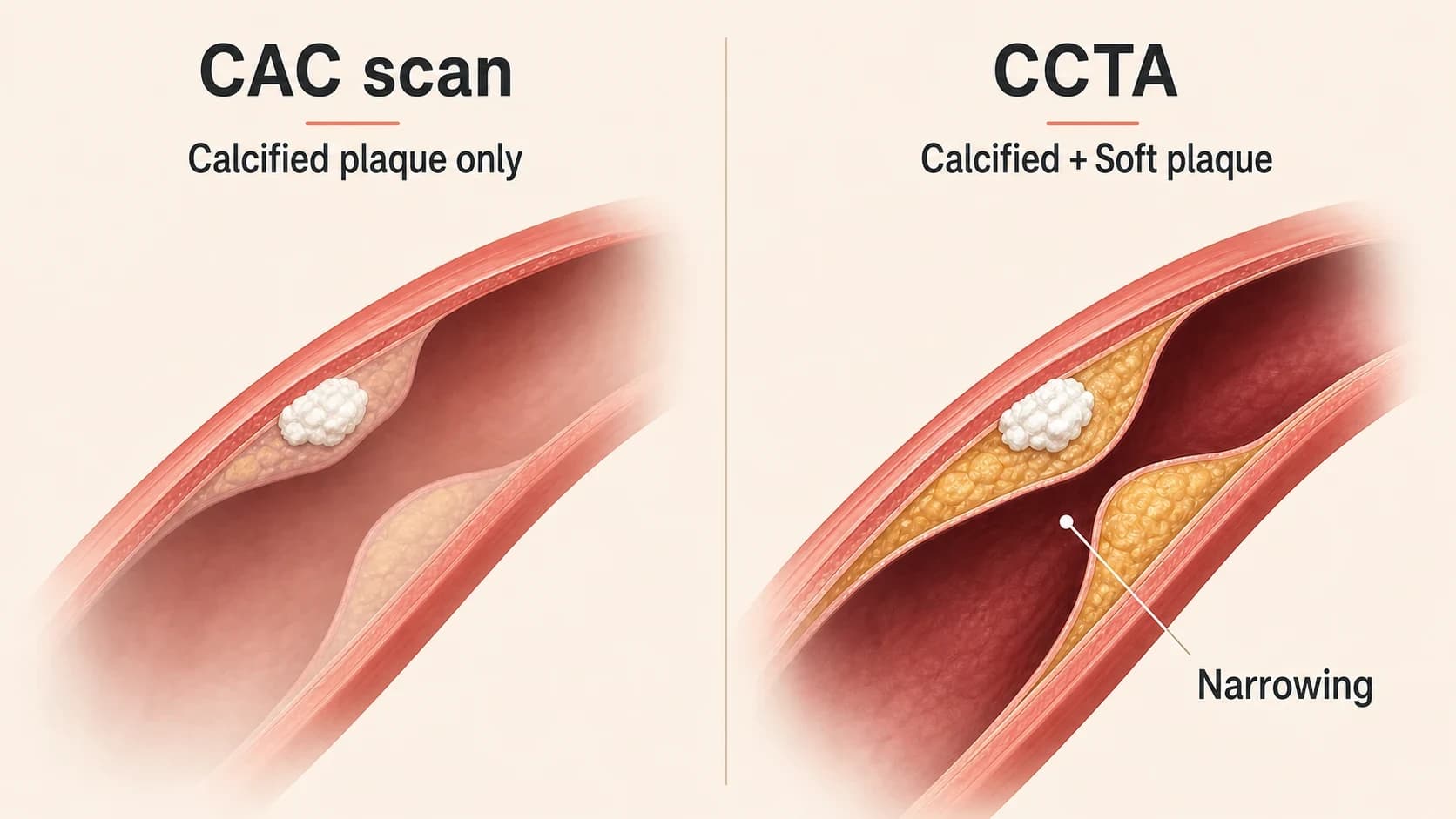
- Unlike a CT angiogram, a CAC test reflects only calcified plaque. It can't detect soft plaque, which can also be dangerous for your heart health.
- A high score may signal that it’s time to start or increase using medications like statins. Your doctor may also recommend heart-healthy lifestyle changes.
What Is a Calcium Score Test?
A calcium score test, formally called a coronary artery calcium test, is a CT scan of your heart that looks specifically for calcium deposits in your coronary arteries, the blood vessels that supply your heart muscle.
A computer analyzes the images and calculates a single number, known as your Agatston score. The higher the number, the more calcified plaque was found in your arteries.
Why Does Calcium Matter?
What’s the point of measuring calcium in your arteries? Simply put, calcium build-up poses a risk to your heart health.
Calcium builds up in arteries as plaque hardens over time, which can narrow or block an artery. The gradual narrowing of arteries from plaque buildup is called atherosclerosis.
Narrowing may lead to:
- Less blood and less oxygen reaching your heart
- Blood flow stopping altogether
- Plaque rupturing and triggering a clot
This can lead to a heart attack.
Imagine your coronary arteries as pipes carrying water through your house. Over years, mineral deposits can build up on the inside walls of old pipes, gradually narrowing the space water can flow through. Calcified plaque works in a similar way inside your arteries, except instead of water, it's blood carrying oxygen to your heart muscle. The calcium score test is essentially a non-invasive way of looking inside those pipes.
Catching plaque buildup early can help you figure out whether you’re at risk of a heart attack — which means you can take preventative measures, like making healthy lifestyle changes or taking a medication.
Calcium Score Tests At a Glance
| Feature | Details |
|---|---|
| What it is | A non-contrast CT scan measuring calcified plaque in your heart arteries |
| Other names | Coronary artery calcium (CAC) score, CAC scan or CAC test, coronary calcium scan, cardiac calcium score, CT calcium score, heart calcium test or calcium heart scan |
| What it measures | Your Agatston score, a single number from 0 upward, which shows how much calcium is in your arteries |
| Time required | About 10 to 15 minutes total |
| Radiation | Low dose, roughly 1 mSv |
| Typical cost | $75 to $400 out of pocket |
| Referral needed? | Varies by facility |
| Who it's generally for | Adults with no symptoms, weighing borderline or intermediate heart disease risk |
| Recovery | No recovery time needed |
Other Names for the Same Test
You might see this test called several different things, depending on where you read about it or which doctor mentions it. They all point to the same scan:
- Coronary artery calcium (CAC) score
- CAC scan or CAC test
- Coronary calcium scan
- Cardiac calcium score or cardiac calcium test
- CT calcium score or CT calcium scoring test
- Heart calcium test or calcium heart scan
- Coronary calcium score
These names all refer to the same test.
Why Does Calcium Build Up In The Arteries?
To understand what a calcium score is telling you, it helps to understand what's actually happening inside your arteries. This process is called atherosclerosis.
Your arteries are lined with a smooth layer of cells. When that lining gets damaged, by high cholesterol, high blood pressure, smoking, or a combination of factors, cholesterol-carrying particles can start to slip into the artery wall itself. Your immune system responds the way it would to any injury, sending cells to the site, which triggers inflammation. Over years, this process builds up a mound of fatty, cholesterol-rich material inside the artery wall, called plaque.
Early on, this plaque is soft and soft plaque is more prone to rupture. When it does, your body responds by forming a blood clot right at that spot. If the clot is big enough to block blood flow to part of your heart, that's a heart attack. If it happens in an artery supplying blood to your brain, that's a stroke.
Over time, some of this plaque calcifies, meaning it hardens with calcium deposits. Research on how coronary calcification develops shows this calcification is generally considered part of the artery's attempt to stabilize the plaque. Calcified plaque is generally more stable than soft plaque, though it also signals that a significant amount of disease has been present for a while, since calcification takes years to develop.
This is the whole reason a calcium score test exists. It can't see the soft, early-stage plaque, but it can detect the calcified plaque that tends to show up after atherosclerosis has been developing for some time, giving you and your doctor a window into a disease process that otherwise has no symptoms until it's already advanced.
What Speeds Up The Calcification Process?
While some people don’t experience calcification at all, others have a great deal of plaque build-up at an early age.

A handful of factors influence how quickly plaque builds and calcifies:
- Cholesterol, especially LDL, since it's the particle that actually deposits into artery walls
- Blood pressure, which damages the arterial lining over time and makes it easier for particles to get in
- Blood sugar and insulin resistance, both of which promote inflammation in the arteries
- Chronic inflammation more broadly, which speeds up how quickly plaque forms and hardens
- Genetics and family history, since some people are predisposed to build plaque faster regardless of lifestyle
- Smoking, which causes chemical damages the arterial lining and accelerates nearly every part of this process
Even people who manage all of these well tend to see some plaque develop over a lifetime, simply because arteries have been exposed to blood flow and pressure for longer with age. That's normal, not a personal failing, and it's part of why age is such a central factor in how calcium scores are interpreted throughout this guide.
How Do You Actually Get a Calcium Score Test?
If you want a calcium score test, there are a few options:
- Hospital-based imaging departments, often the same place you'd go for other CT scans or X-rays
- Freestanding imaging centers, which frequently offer lower self-pay prices than hospitals
- Direct-to-consumer heart screening services, which specialize in preventive scans and sometimes offer same-day or next-day appointments
- Your cardiologist's office, if you already see one, since many have in-house or affiliated imaging
Some facilities require a referral from your doctor or cardiologist, while others may not. You’ll have to call ahead of time to ask what the referral policy is at that specific facility.
What Does A Calcium Score Test Cost?
Most people pay out of pocket. Typical self-pay pricing runs from about $75 to $400, with most people landing somewhere between $100 and $200 depending on location and facility type.
Hospital-based scans tend to run higher than freestanding imaging centers, and prices in major metro areas are often higher than in smaller cities.
Medicare generally doesn't cover calcium score testing when it's done for screening purposes, and most private insurance plans classify it the same way, as an elective screening test rather than a covered diagnostic service.
A small number of states have passed laws requiring certain insurance plans to cover it under specific circumstances, so it's worth checking your own plan and state rules if cost is a concern.
Where insurance doesn't apply, HSA and FSA funds typically can be used to cover the cost, since it qualifies as a preventive health expense.
Getting a Calcium Score Test, Step by Step
| Step | What Happens |
|---|---|
| 1. Decide if it's right for you | Talk to your doctor, or review the eligibility guidance later in this guide |
| 2. Find a facility | Search for imaging centers, hospital radiology departments, or direct-to-consumer heart screening services near you |
| 3. Confirm referral requirements and cost | Call ahead, since this varies by facility and location |
| 4. Schedule your scan | Many facilities offer same-day or next-day appointments |
| 5. Complete the scan | About 10 to 15 minutes, including check-in |
| 6. Receive your results | Usually within a few days, sometimes sooner |
| 7. Discuss with your doctor | Bring your report to your next appointment, or schedule one specifically to review it |
What Happens During a Calcium Score Scan
The scan itself is simple and doesn't involve much beyond lying still. Here's what to expect, step by step:
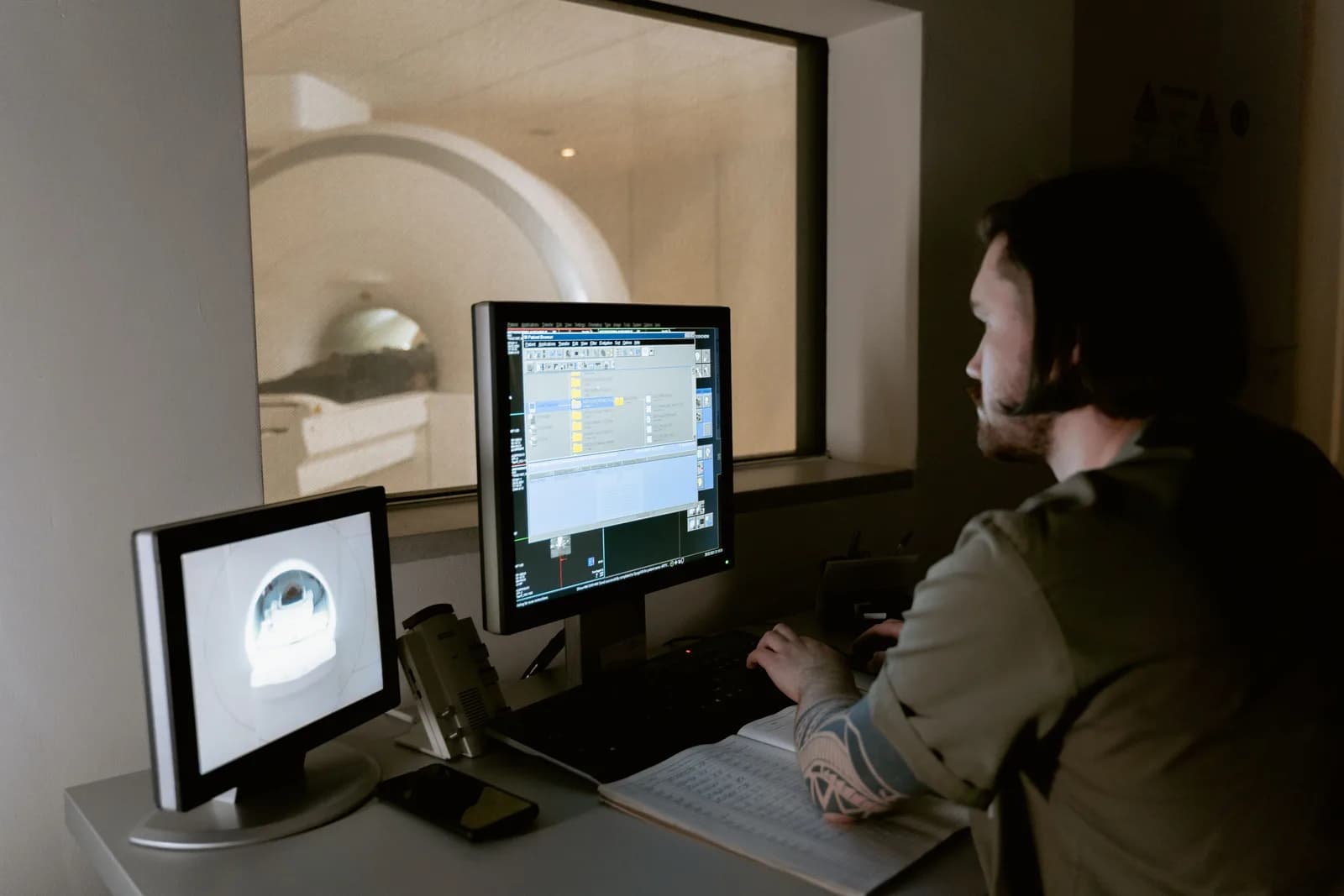
- You'll change into a gown if needed, and remove any metal jewelry or clothing with metal snaps near your chest.
- A technologist places a few ECG leads on your chest so the machine can time each image to your heartbeat.
- You'll lie on a table that slides into a CT scanner, a large ring-shaped machine, not an enclosed tube.
- You'll be asked to hold your breath for a few seconds at a time, a handful of times, while the scanner captures images.
- No contrast dye is used, which sets this test apart from a coronary CT angiogram and means no needle or IV is required.
The scan itself takes just a few minutes. Including check-in and paperwork, most visits run about 10 to 15 minutes from start to finish. There's no recovery time needed, and you can drive yourself home or return to work immediately afterward.
How to Prepare for a CAC Scan
Prep for a calcium score test is minimal:
- No fasting required. Eat and drink normally beforehand.
- Avoid caffeine and smoking for a few hours before your scan, since both can raise your heart rate and make the images harder to read.
- Wear a shirt without metal snaps, buttons, or zippers near your chest, since metal can interfere with the images.
- Keep taking your regular medications unless your doctor tells you otherwise.
- Bring a form of ID and any insurance information, even if you're paying out of pocket, since some facilities ask for it regardless.
That's it. There's no IV, no sedatives, and no recovery time needed.
Is a Calcium Score Test Safe?
Overall, a calcium score test is considered safe. While it involves some radiation exposure, it’s a tiny amount. Let’s put this into context.
A calcium score test uses a low dose of radiation, typically around 1 mSv. For comparison, the average person is exposed to somewhere between 2 and 5 mSv of background radiation every year just from daily life, cosmic radiation, the ground, even the air you breathe contains trace radioactive particles.
Put simply, the radiation from a single calcium score test is a small fraction of what you're exposed to naturally over the course of a year, and it's a dose most radiologists consider very low risk for a one-time or even periodic screening test.
Who Should Get a Calcium Score Test?
The 2026 ACC/AHA dyslipidemia guidelines, which were created with the American College of Cardiology and American Heart Association, covers best practices for diagnosing and treating heart disease.
The guidelines recommend that the following groups of people consider getting a calcium score test:
- Men age 40 and older, and women age 45 and older
- Adults with no symptoms and no known heart disease
- People for whom the intensity of cholesterol-lowering treatment is genuinely uncertain
- Those falling into a borderline or intermediate 10-year risk category under the PREVENT equations
In plain terms, this test is built for people in the “gray zone” — those who may be at risk of developing heart disease.
Who Should Skip a Calcium Score Test?
A calcium score test isn't for everyone. Your doctor will likely advise you against a CAC test if you:
- Are already diagnosed with heart disease, since the test won't add information your doctor doesn't already have
- Are pregnant, due to the radiation exposure — although the radiation exposure is low, it may be dangerous for the fetus
- You’re already known to be at very high or very low risk, where the result is unlikely to change treatment
If you're not sure which category you fall into, that's a good question for your doctor rather than something to guess at on your own.
How To Read Your Calcium Score Results
Your result comes back as a number starting at zero. Broadly:
| Score | Category | What It Generally Means |
|---|---|---|
| 0 | None | No calcified plaque detected |
| 1 to 10 | Minimal | A very small amount of plaque |
| 11 to 100 | Mild | Plaque is present, at an early stage |
| 101 to 400 | Moderate | A meaningful amount of plaque |
| 401 to 999 | Extensive | A large amount of plaque |
| 1,000 or higher | Very Extensive | A very large amount, its own closely studied high-risk category |
These bands are a starting point, not the full picture. Your number also needs to be read against your age and sex, since what's typical shifts substantially over a lifetime, and against the specific details your doctor will walk you through, including which arteries the calcium shows up in and how that fits your broader risk profile.
Read moreCalcium Score Ranges: What Your Results and Report Actually MeanUnderstanding Vessel-by-Vessel Results
Your total score is actually a sum of four numbers, one for each major coronary artery:
- The left main (LM) artery, which feeds the largest share of the heart
- The left anterior descending (LAD) artery, which supplies blood to the front wall of the heart
- The left circumflex (LCX) artery, which wraps around the side and back of the heart
- The right coronary artery (RCA), which supplies the bottom of the heart, including part of the electrical system that keeps your heartbeat regular
Most reports list each separately before adding them into the total you see at the top.
The raw number matters, but so does the location of the calcium build-up. Calcium in the left main artery, even in a relatively small amount, has been linked to meaningfully higher risk than the same amount elsewhere, since the left main feeds a larger share of heart muscle than any other single vessel.
Percentile vs. Raw Score
Here's a distinction that confuses a lot of people. Your raw score tells you how much calcified plaque was found, full stop. Your percentile tells you how that amount compares to other people your age and sex, since a score that's unremarkable at 75 would be unusual at 45.
A score of 100 in your mid-40s could put you above the 90th percentile for your age, a signal worth taking seriously. That same 100 in your mid-70s might land you closer to the middle of the pack. Both numbers matter, but they're answering different questions, and reading your result well means knowing both.
Use the calculator below to see how your Agatston score compares to your peers’.
What If My Calcium Score Is High?
A high score isn't a diagnosis on its own, and it isn't a death sentence. It's a signal to have a more focused conversation with your doctor about lowering your risk.

Scores above 100 are generally where doctors start weighing more active treatment, which might include:
- A statin
- Bempedoic acid, a newer alternative to statins
- Newer medication, like ezetimibe or PCSK9 inhibitors
- Low-dose aspirin (in certain circumstances)
- Treatment for high blood pressure
- Treatment for blood sugar control
Lifestyle changes matter just as much, and you may try:
- A heart-healthy diet
- Regular aerobic activity
- Managing stress
- Getting enough sleep
- Quitting smoking
Lifestyle changes can make a significant difference in slowing down plaque build up and supporting heart health.
None of this can reverse your calcium score. Once plaque calcifies, it doesn't disappear. But addressing these factors can slow further buildup and lower your overall risk of a heart attack.
Read moreWhat Is the Treatment for a High Calcium Score?How Worried Do I Need To Be?
Receiving a high score can be scary. It means you’re at risk of having a heart attack — but it doesn’t mean you’ll definitely have a heart attack.
It's worth keeping this in mind: research following people with even the highest calcium scores for over a decade found their annual risk of dying from cardiovascular disease was still under 1 percent per year. That's a serious risk worth treating, but it's a manageable one, not a countdown.
So, a high score means it’s time to take action (like taking medication and taking on healthy lifestyle changes). But it generally doesn’t mean you need to panic. Rather speak with your doctor to get a good idea of your heart health and how to protect it.
Related guideLDL cholesterol: The number worth knowingWhat If My Calcium Score Is Low — Or Zero?
A score of zero means no calcified plaque was found, and it's one of the most reassuring results this test can give.
But it isn't an absolute guarantee that you won’t have a heart attack. It also doesn’t mean you won’t have calcium build-up at a later stage.
Research suggests roughly a quarter to a third of heart attacks still occur in people whose calcium score was zero. Usually, their disease was still in the soft-plaque stage when they were scanned. Soft plaque can’t be detected with a CAC test, but it can still damage your heart — either by rupturing or hardening over time.
Read moreWhat does a calcium score of zero mean?A low calcium score also doesn’t mean you shouldn’t take your heart health seriously. While you may not need medication, you can still be proactive about your well-being.
Focus on the following:
- Eat a heart-healthy diet including lean protein sources, vegetables, legumes, and plenty of water. Avoid ultra-processed foods, saturated fats, excessive sodium, and added sugar.
- Stay physically active. Aim for regular aerobic exercise. Most guidelines suggest at least 150 minutes a week of moderate cardio activity, since it helps manage your long-term risk.
- Avoid smoking, or quit if you currently smoke. Smoking damages your arteries directly. It’s one of the most significant risk factors for heart disease, regardless of what your calcium score shows today.
- Manage stress well. Chronic stress can raise blood pressure and contribute to unhealthy coping habits over time. Regular exercise, adequate sleep, and staying connected to people you trust all help keep your stress response in check.
- Check your other numbers. A low or zero calcium score doesn't mean your cholesterol, blood pressure, and blood sugar are automatically fine. Keep up with regular checkups so these stay in a healthy range.
- Ask about your Lp(a). Lipoprotein(a) is a genetic cholesterol-related marker that doesn't show up on a calcium score. Everyone should have their lipoprotein(a), or Lp(a), cholesterol marker checked at least once in their life, since a high level can raise your risk independent of your calcium score.
- Take heart disease symptoms seriously. Regardless of your last scan, seek medical attention if you experience the symptoms of heart disease — like chest pain, shortness of breath, or unusual fatigue.
It’s also a good idea to ask your doctor when you should have another CAC test. Retesting every so often can help you keep an eye on your calcium build-up.
What a Calcium Score Test Can't Tell You
A calcium score test has one significant blind spot: soft plaque.
A CAC test only sees calcified, hard plaque. It has no way of detecting soft plaque, which hasn't hardened yet and is often the kind more likely to rupture and cause a heart attack.
Soft plaque can make up a large share of total plaque volume in some people, so a low or even zero score doesn't fully rule out risk. This matters especially in younger people, where hardening plaque simply hasn't had time to accumulate yet.
This is also why a calcium score test isn't a substitute for imaging that can see both kinds of plaque, like a coronary CT angiogram. A CT angiogram is a more advanced scan that can detect both soft and calcified plaque. It also shows you where the plaque is built up. If you want more confidence in your heart health, it’s worth considering a CT angiogram.
Calcium Score vs. Other Heart Tests
A CAC scan isn’t the only test designed to check your heart health. There are numerous other tests, each with their own functions, benefits, and limitations.
It's easy to lose track of how a calcium score test fits alongside the other heart tests you might hear about. Here's a quick comparison:
| Test | What It Shows | Contrast Dye? | Best For |
|---|---|---|---|
| Calcium score (CAC) | Calcified plaque only | No | Screening asymptomatic adults at borderline or intermediate risk |
| Coronary CT angiogram (CCTA) | Both calcified and soft plaque, plus blockages | Yes | A fuller picture of plaque, especially with symptoms or risk factors a calcium score can't explain |
| Stress test | How your heart performs under exertion | Sometimes | Evaluating symptoms like chest pain during activity |
| Blood lipid panel | Cholesterol and related blood markers | No | Baseline risk assessment, monitoring treatment |
| EKG (electrocardiogram) | Your heart's electrical activity | No | Detecting rhythm problems, some signs of prior heart damage |
None of these tests fully replaces the others. They each answer a different question, and your doctor may recommend more than one depending on your situation.
Your doctor can help you figure out which tests you should get (if any).
Frequently Asked Questions about Calcium Score Tests
Not always. It depends on the facility. Some require a physician's order, and others let you book directly. Calling ahead is the easiest way to find out.
Usually not when it's done for screening purposes. Medicare and most private insurers classify it as elective, though a small number of states require coverage under specific conditions, and HSA or FSA funds typically can be used.
It's very good at measuring what it's designed to measure: calcified plaque. Its main limitation isn't accuracy but its scope, since the scan can't see soft, non-calcified plaque at all. A CT angiogram can detect both soft and hardened plaque.
Yes, though it's less commonly recommended at younger ages since calcification is rarer before 40. Some younger adults with strong family history or other risk factors still choose to get one after talking with their doctor.
There's no universal answer. Research suggests a zero score tends to hold for several years in lower-risk people, but your doctor can advise on timing based on your specific risk factors.
You'll want to review them with a doctor, who can help interpret your score in the context of your full risk profile and recommend next steps if needed. If your score is high, you may be prescribed medication as well as lifestyle changes. And even if your score is low, it’s still worth maintaining healthy habits — and you may need to retest in a few years’ time.
Not directly. It measures calcified plaque, which is associated with cardiovascular risk, but it doesn't diagnose an active blockage or predict exactly when or if a heart attack might happen. It's a risk-assessment tool, not a crystal ball.
The Bottom Line on Calcium Score Tests
A calcium score test is a quick, low-radiation CT scan that measures calcified plaque in your heart arteries and reports it as a single number. It's generally aimed at adults aged 40 to 75 who are at borderline or intermediate risk and weighing whether to start a statin.
This is one of many tests that can help you figure out whether you’re at risk of having a heart attack.
8 Sources
American Heart Association Coronary artery calcium test (2026)
https://www.heart.org/en/health-topics/heart-attack/diagnosing-a-heart-attack/cac-testAmerican Heart Association American Heart Association recommendations for physical activity in adults and kids (2024)
https://www.heart.org/en/healthy-living/exercise-and-physical-activity/fitness-basics/aha-recs-for-physical-activity-in-adultsAmerican Heart Association Predicting Risk of cardiovascular disease EVENTs (American Heart Association PREVENT™) (2026)
https://professional.heart.org/en/guidelines-and-statements/about-prevent-calculatorBos D, Leening MJG Leveraging the coronary calcium scan beyond the coronary calcium score (2018)
https://pmc.ncbi.nlm.nih.gov/articles/PMC5986828Family Heart Foundation Cardiac CT calcium score: your guide to understanding results and risk (2025)
https://familyheart.org/cardiac-ct-calcium-scoreGrundy SM, Stone NJ, Bailey AL, et al. 2018 AHA/ACC/AACVPR/AAPA/ABC/ACPM/ADA/AGS/APhA/ASPC/NLA/PCNA guideline on the management of blood cholesterol (2019)
https://www.ahajournals.org/doi/10.1161/cir.0000000000000625Gupta A, Bera K, Kikano E, et al. Coronary Artery Calcium Scoring: Current Status and Future Directions (2022)
https://pubmed.ncbi.nlm.nih.gov/35657766/Mohan J, Shams P, Bhatti K, et al. Coronary Artery Calcification (2024)
https://www.ncbi.nlm.nih.gov/books/NBK519037/