
Written by Arvind Srivastav
Updated
ApoB counts every plaque-causing particle in your blood. It's more accurate than LDL. Here's what your number means, how it compares to LDL, and how to lower it.
Written by Arvind Srivastav
Updated
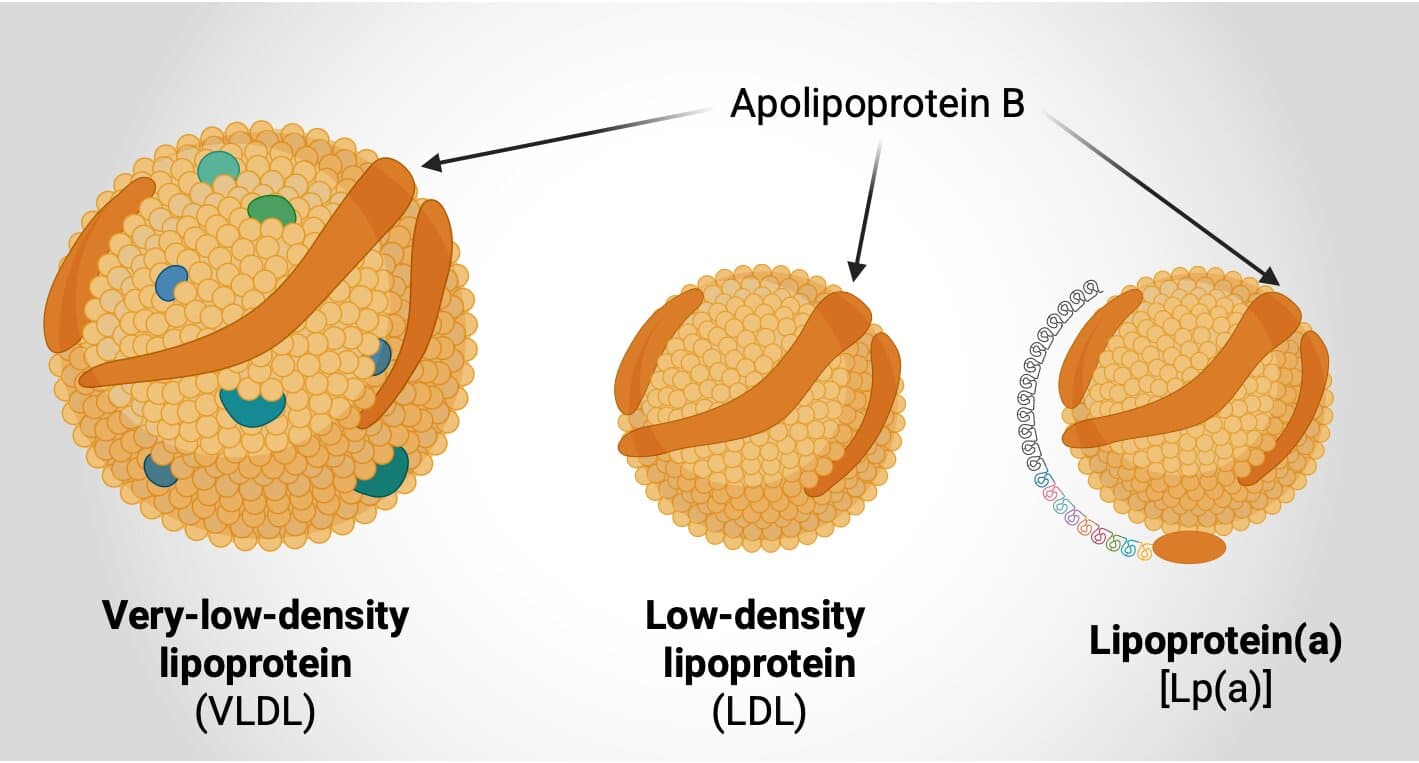
You probably know LDL as "bad cholesterol." But LDL doesn't tell you the whole story. ApoB counts the actual number of particles in your blood that can cause plaque buildup. When the two measurements disagree, ApoB is the better predictor of heart disease. The 2026 ACC/AHA guidelines now recognize it as a key tool for understanding your real risk.
Every particle in your blood that can build plaque has exactly one ApoB protein attached to its surface. That includes LDL particles, VLDL, and Lp(a). Count the ApoB, and you've counted every particle that can damage your arteries.
Think of it this way: your cholesterol particles are delivery trucks driving through your bloodstream. LDL tells you how much cargo (cholesterol) the trucks are carrying. ApoB tells you how many trucks are on the road. What damages your arteries is the number of trucks that crash into the walls, not the cargo inside them.
| LDL-C | ApoB | |
|---|---|---|
| What it measures | Cholesterol cargo inside LDL particles | Total number of plaque-causing particles |
| How it's measured | Calculated from other numbers | Directly measured (more accurate) |
| Fasting needed? | Sometimes | No |
| Accurate with high triglycerides? | No (often underestimates risk) | Yes |
| On standard lipid panel? | Yes | No (you have to ask for it) |
Two people can have the exact same LDL number but very different numbers of particles. The person with more particles has a higher risk, even though their LDL looks the same. This mismatch is common in people with insulin resistance, prediabetes, diabetes, obesity, or high triglycerides.
A landmark study (CARDIA) followed young adults for 25 years and found that those with high ApoB but normal LDL had a 55% higher risk of developing plaque. Those with high LDL but normal ApoB did not show increased risk. In other words, when the two disagree, ApoB tells the truth.
The key insight
9%
Each 10 mg/dL drop in ApoB is associated with approximately 9% lower risk of heart disease.
Your target depends on your overall risk. Here's how to read your number alongside the targets from the 2026 ACC/AHA guidelines and the National Lipid Association:
| Risk level | ApoB target | Who this applies to |
|---|---|---|
| Very high risk | < 60 mg/dL | Existing heart disease, or multiple high-risk conditions |
| High risk | < 70 mg/dL | Diabetes, high calcium score, or familial hypercholesterolemia |
| Moderate risk | < 90 mg/dL | Healthy adults with some risk factors |
Some longevity-focused physicians aim for ApoB below 60 mg/dL for all patients, regardless of current risk. The lower the ApoB, the lower the lifetime risk.
If your ApoB comes back above 130 mg/dL, that's considered very high. Between 100 and 130 is high. Between 90 and 99 is borderline. Below 90 is where most guidelines want you to be, though lower is generally better.
Several factors can push your ApoB up:
ApoB is not included on a standard lipid panel. You need to ask your doctor to order it by name. No fasting is required, and it can be added to any routine blood draw.
Ideally, check ApoB every time you check your cholesterol. At minimum, get it once as a baseline, paired with an Lp(a) test to get a complete picture of your particle risk.
ApoB testing is especially valuable if you have diabetes, high triglycerides, insulin resistance, or a family history of early heart disease. These are the situations where LDL is most likely to underestimate your actual risk.
The good news: unlike Lp(a), ApoB responds well to both lifestyle changes and medication. You can start seeing results in 6 to 12 weeks.
If lifestyle alone isn't enough, medications can make a significant difference:
| Treatment | ApoB reduction |
|---|---|
| Diet and lifestyle changes | 5–15% |
| Statins | 24–45% |
| Ezetimibe (add-on to statins) | 10–15% |
| Bempedoic acid | 10–15% |
| PCSK9 inhibitors (add-on to statins) | 50–60% |
Reductions are approximate and vary by individual. Combining treatments has a compounding effect.
Your ApoB target depends on your overall cardiovascular risk. If you're not sure where you fall, a calcium score or coronary CT angiogram can help clarify. Imaging shows you whether plaque has already started to form, which determines how aggressively you and your doctor should treat your ApoB.
ApoB is the single best blood test for measuring your plaque-building risk. It should be on every cholesterol panel, but it's not there yet. Ask for it. Know your number. And if it's high, the tools to bring it down are well-proven and effective.
American Heart Association / American College of Cardiology 2026 ACC/AHA Guideline on the Management of Dyslipidemia (Circulation)
https://www.ahajournals.org/doi/10.1161/CIR.0000000000001423National Lipid Association Role of apolipoprotein B in the clinical management of cardiovascular risk in adults: Expert Clinical Consensus
https://pmc.ncbi.nlm.nih.gov/articles/PMC11734832/American Heart Association (Circulation) Apolipoprotein B: bridging the gap between evidence and clinical practice
https://www.ahajournals.org/doi/10.1161/CIRCULATIONAHA.124.068885Empirical Health Each 10 mg/dL drop in ApoB cuts heart disease risk by 9%
https://www.empirical.health/blog/apob-blood-test/National Institutes of Health (PMC) Apolipoprotein B but not LDL cholesterol is associated with coronary artery calcification in type 2 diabetic whites (CARDIA)
https://pmc.ncbi.nlm.nih.gov/articles/PMC2712798/Journal of Clinical Lipidology ApoB, LDL-C, and non-HDL-C as markers of cardiovascular risk (2025)
https://www.lipidjournal.com/article/S1933-2874(25)00315-0/abstractPeter Attia, MD How early and aggressive lowering of apoB could change the course of ASCVD
https://peterattiamd.com/early-and-aggressive-lowering-of-apob/American Heart Association (Circulation) The lower the ApoB, the better
https://www.ahajournals.org/doi/10.1161/CIRCULATIONAHA.122.061188Empirical Health Why ApoB is more accurate than LDL cholesterol
https://www.empirical.health/blog/apob-vs-ldl-cholesterol/MDPI Diagnostics Apolipoprotein B as the stronger lipid-related predictor of coronary artery disease in statin-treated patients (2025)
https://www.mdpi.com/2075-4418/15/23/3002